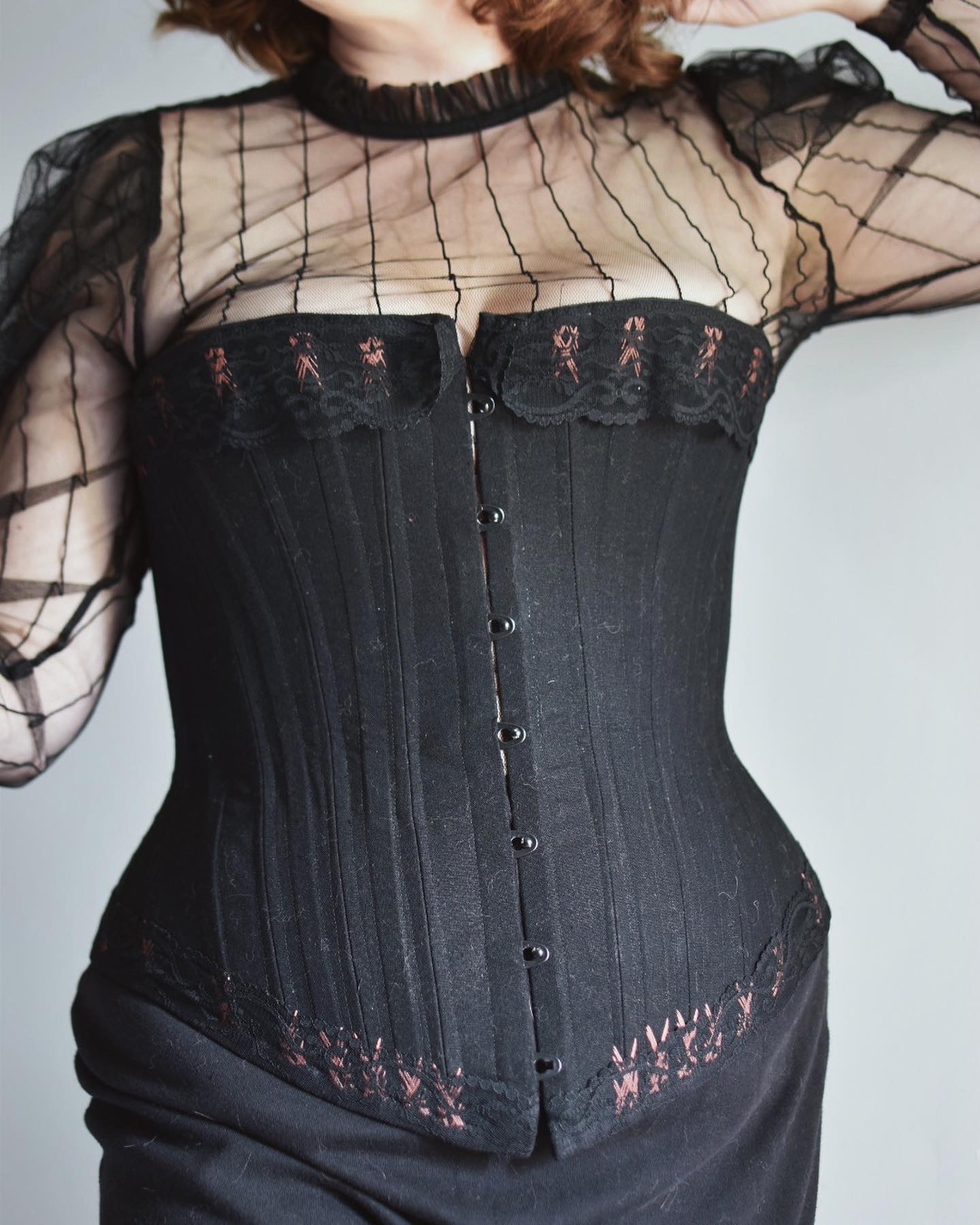

Today we’re going to review my first attempt at a full length corset. To preface, I made this for a particular costume (not shown) that was meant to be historically inspired rather than historically accurate. Secondly, the Victorian era is not my usual bag, so I have less knowledge besides what I’ve gleaned from Bernadette Banner videos. As a result, I am going to list below the key mistakes I made so if you are also getting into corsetry you can learn from my fuck ups. [AN: here I stared into the middle distance, weighing whether I wanted to use curse words on my own blog. But whatever, it’s not like I make money off this damn thing]
Please note I am not an expert and the following is based on my limited knowledge of the craft.
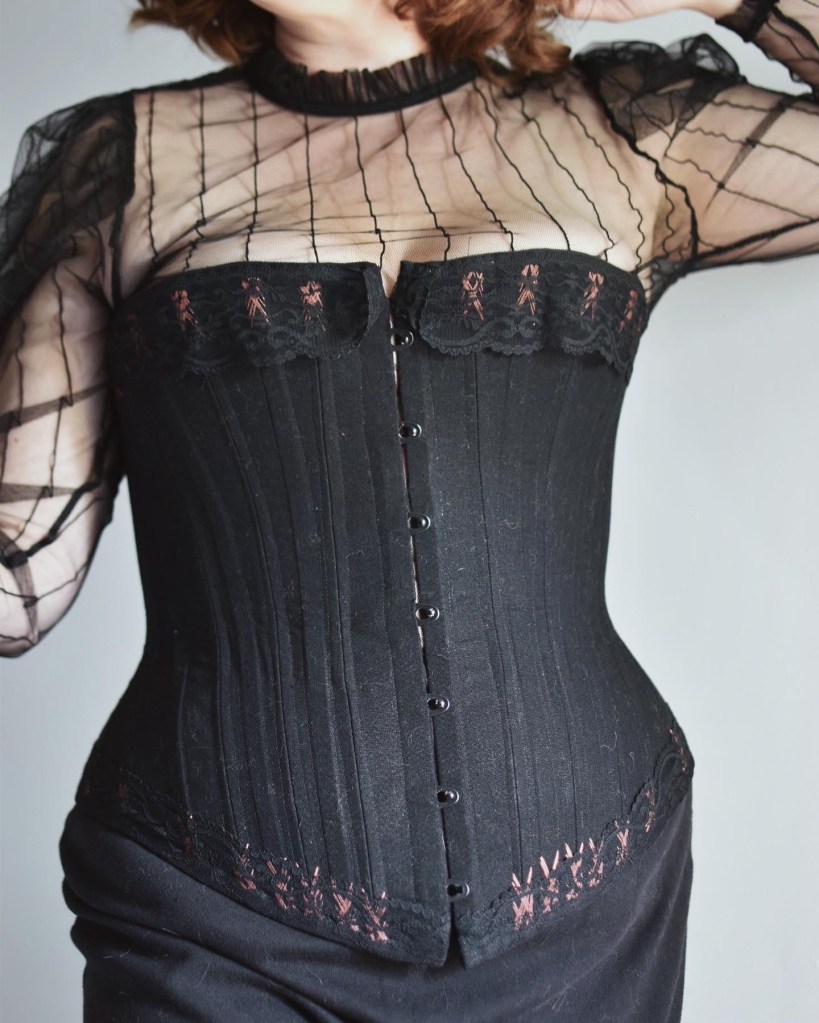
Before we get into that, a brief pattern review. I chose Aranea Black’s Dahlia, an 1886 riding corset. It has nice clean vertical lines and your classic hourglass shape, but looks a little more comfortable than a fashion corset from this era. It’s a free pattern and is definitely geared more towards an intermediate sewist. The instructions are fairly sparse, though it does include a decent section on fitting. I ended up supporting her Patreon page for a few months and she also has a chemise and a corset cover pattern (plus quite a few other things I wasn’t interested in at the time—it’s worth a peruse).
Anyway. On to what we’re all waiting for:
The Downfalls
1. Padding
If you already noticed from the first photo, the bust line is indecent. I have to be very careful when (rarely) wearing this as a fashion moment. I had too much room at the bust and hips during fitting and I just pinched in and took some out. It turns out a better practice would be to mostly pad out some and then pinch out where needed. Padding helps with support and comfort, while just pinching out fabric removes space and can create a less supportive environment. So I ended up pinching out on the top and leaving the bottom too large. Sigh. If I wasn’t already done with the rest of the issues with this corset, I would pad out the hips as well.
2. The Busk
Why oh why did I choose the modern straight busk version and not the historical spoon busk??
3. Embellishments
Okay, so the lace situation. It’s fine, but it’s really just there to hide the flossing. It’s just second hand poly lace, it’s whatever. I had thought to color coordinate the flossing with another aspect of my costume (maybe one day I’ll post about it once I get proper pictures), but I did a pretty sloppy job and decided this was the way to fix it without removing all my work and redoing it.
4. The Whole Back Situation
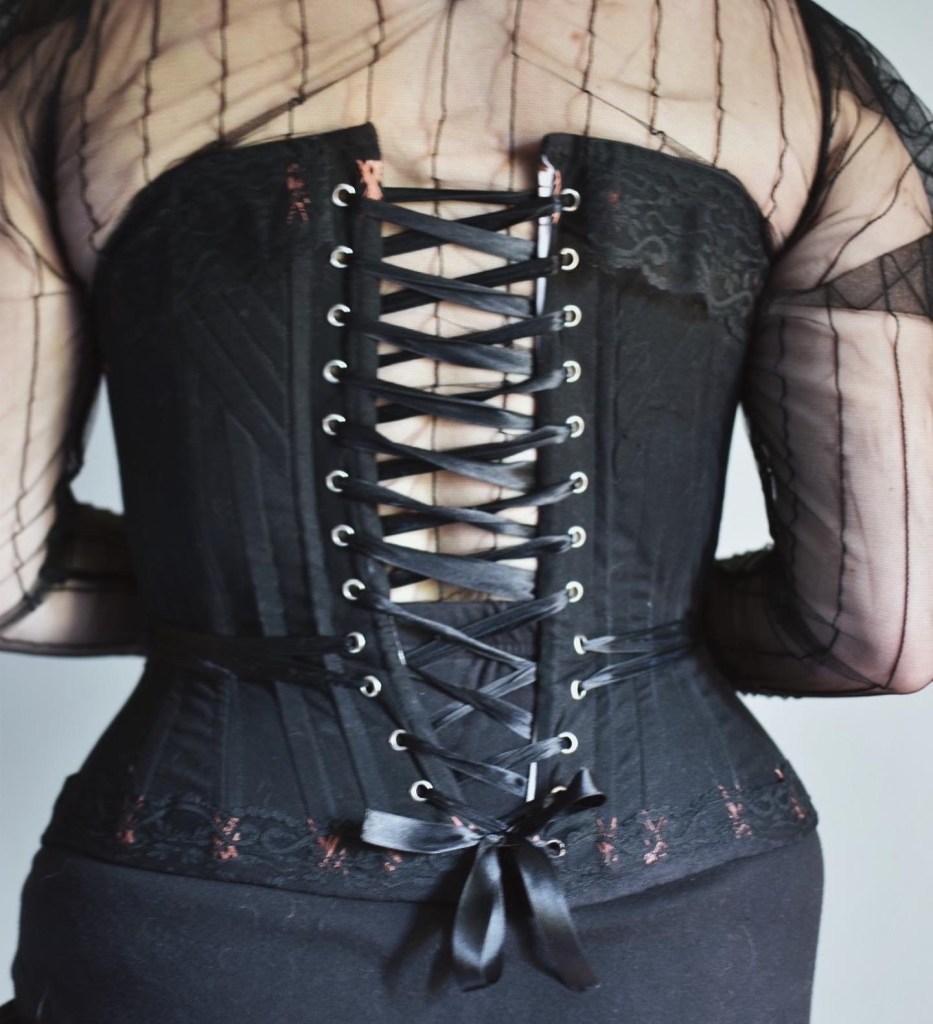
Owie. This is probably the worst sin of this whole project and the most painful. Over Halloween weekend I wore this almost three days in a row and ended up with an annoying back pain for a couple days after. It’s just proof that a poorly fitting corset is so bad for you omg. Because it is not fitted properly as per my first complaint, the back lacing isn’t parallel. One of the effects of this is the bones in the back were flipping and digging into my back in the worst ways (part of the problem is the last two boning channels were too big, which I have since fixed though it didn’t solve this issue).
Honestly the next time I need a late Victorian corset, I’m scrapping this guy and making a totally new one. While the base pattern isn’t the problem, I think I’d try a different style just to mix things up. I’m particular to the late Victorian to Edwardian era, so that’s probably what I would stick to. Anyway, I learned so much during this project so it’s not a loss in my mind. I’ve worn it to several events and while I wish it would have gotten a bit more use, I did realize my first project wouldn’t be great and I’d have to redo it. Sometimes as a maker you spend hours of your life on something that isn’t worth it and that’s just part of the process. You’ll get there some day and so will I. 🌼
 Dropout Daisy
One thought on “Aranea Black corset pattern review”